Glucose Oxidase Activity Assay: Process Guide for Baking
B2B guide to glucose oxidase activity assay setup for baking: conditions, dosage, QC checks, COA review, pilot trials, and cost-in-use.
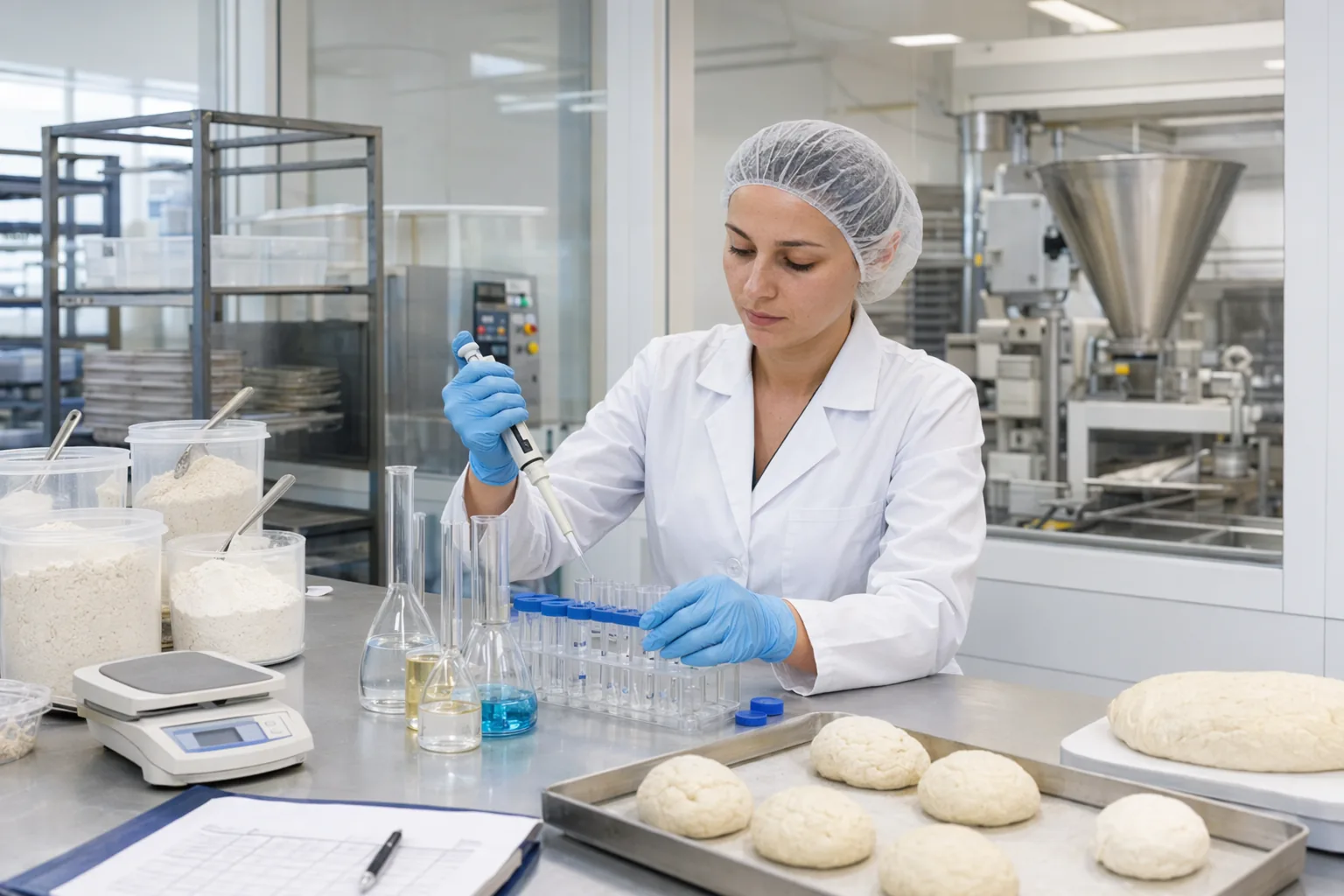
A practical guide for bakery R&D, QA, and procurement teams evaluating glucose oxidase for dough strengthening, process consistency, and supplier qualification. Written for bakery manufacturers, flour mills and ingredient distributors buying glucose oxidase in bulk; grades and volumes are quoted per order.
Why Glucose Oxidase Activity Matters in Baking
Glucose oxidase is used in baking to support dough strength and handling by catalyzing the oxidation of glucose in the presence of oxygen. The GOx enzyme converts glucose to gluconic acid and hydrogen peroxide; in dough systems, hydrogen peroxide can support oxidative cross-linking effects that influence gluten network behavior. A glucose oxidase activity assay gives bakery manufacturers a controlled way to compare lots, qualify new suppliers, and prevent under- or over-dosing during production. Unlike a finished bake test, the assay isolates enzyme activity under defined pH, temperature, substrate, and time conditions. For B2B buyers, the goal is not simply to find the highest activity product, but to match activity, formulation form, carrier, stability, and cost-in-use to the actual bakery process.
Common application targets include dough tolerance, gas retention, loaf volume, and handling consistency. • Activity results should be connected to flour type, fermentation time, mixing energy, and oxidant system. • Assay data should be reviewed alongside pilot bake results before commercial adoption.
Core Glucose Oxidase Activity Assay Principle
A standard glucose oxidase assay measures the rate of glucose oxidation under controlled conditions. In many industrial QC workflows, glucose is supplied as the substrate, oxygen participates in the reaction, and hydrogen peroxide formation is monitored using a coupled colorimetric or oxygen-based method. The selected method should be clearly described in the supplier TDS or internal QC procedure, including substrate concentration, buffer, pH, temperature, reaction time, and activity unit definition. Because different suppliers may define one unit differently, activity values are not always interchangeable without method alignment. Buyers should ask whether the glucose oxidase enzyme activity on the COA was measured using the same assay basis used for product release and shelf-life claims.
Confirm the activity unit definition before comparing quotations. • Use a reference lot or internal control sample for trending. • Check whether the assay is colorimetric, oxygen-consumption, or peroxide-based. • Record incubation time, pH, temperature, and dilution factor for every test.
Recommended Process Conditions for Screening
For bakery evaluation, begin with a laboratory glucose oxidase activity assay and then run bench dough trials under realistic plant conditions. Many GOx enzyme products show useful activity around pH 5.0-6.5, which overlaps with typical dough systems, but exact optima depend on source and formulation. Assay temperatures often range from 25-40°C, while baking trials should reflect sponge, straight-dough, frozen dough, or high-speed mixing conditions. Initial dosage screening is commonly performed in low ppm ranges based on flour weight, then adjusted by flour quality and process response. Avoid assuming that a higher assay number automatically improves baking; too much oxidative effect may tighten dough, reduce extensibility, or create inconsistent machinability.
Suggested bench screen: 5-50 ppm enzyme preparation on flour weight, adjusted to product activity. • Assay pH screen: pH 5.0, 5.5, 6.0, and 6.5 when flour systems vary. • Assay temperature screen: 25°C, 30°C, and 37°C for comparative mapping. • Bake-trial checks: mixing tolerance, dough stickiness, proof stability, volume, crumb, and sliceability.
Translating Assay Results into Bakery Performance
The most useful glucose oxidase activity assay program links analytical data to functional results. A bakery team may receive two lots with similar activity values, yet observe different dough behavior due to carrier composition, particle size, side activities, moisture, or storage history. For that reason, incoming QC should include both activity confirmation and application checks. A practical program includes COA verification, retained-sample testing, flour-specific bake trials, and trend charts for critical quality attributes. When glucose oxidized by the enzyme generates hydrogen peroxide, the functional impact depends on dough oxygen availability, mixing intensity, formula reducing agents, and other enzymes in the improver system. Always validate the complete formulation, not the enzyme in isolation.
Compare assay activity with farinograph, extensograph, or internal dough handling scores where available. • Track finished bread volume, crumb resilience, crust color, and staling indicators. • Evaluate interactions with amylase, xylanase, lipase, ascorbic acid, and emulsifiers. • Confirm whether the enzyme is intended for flour treatment, improver blends, or direct dough dosing.
Supplier Qualification and Cost-in-Use
Industrial enzyme procurement should evaluate total value, not only quoted price per kilogram. A lower-priced glucose oxidase may be less economical if higher dosing, shorter shelf life, special storage, or inconsistent lot performance increases waste. Request the COA for activity and microbiological limits, the TDS for handling and application guidance, and the SDS for safe storage and worker protection. Supplier qualification should also review allergen statements where relevant, country-of-origin documentation, packaging integrity, lead time, lot traceability, and change-notification practices. Before plant approval, run pilot validation at minimum, target, and maximum proposed dosages. Convert trial results into cost-in-use per metric ton of flour or finished product to support purchasing decisions.
Request COA, TDS, SDS, shelf-life statement, storage guidance, and lot traceability. • Run side-by-side trials against current enzyme or control formula. • Calculate cost-in-use using actual effective dosage, not catalog activity alone. • Define acceptance criteria before placing recurring orders.
Technical Buying Checklist
Buyer Questions
It helps buyers confirm that a glucose oxidase lot delivers the declared activity before it enters production. The assay should be used with COA review, retained-sample comparison, and pilot baking. Procurement teams should compare suppliers by activity definition, effective dosage, shelf life, documentation quality, and cost-in-use rather than price per kilogram alone.
A practical first screen is often 5-50 ppm of enzyme preparation on flour weight, but the correct dosage depends on declared activity, flour strength, formula, fermentation time, and mixing intensity. Start with minimum, target, and maximum trial points. Confirm performance through dough handling, proof stability, loaf volume, crumb texture, and line machinability.
No. A glucose oxidase assay confirms catalytic activity under controlled conditions, but bakery performance depends on the full dough system. Oxygen availability, pH, flour proteins, reducing agents, other enzymes, and processing time all affect results. Use the assay for QC and supplier comparison, then confirm the selected dosage through pilot and plant-scale trials.
Request a COA showing lot-specific activity and release checks, a TDS describing application guidance and assay basis, and an SDS covering safe handling and storage. Also ask for shelf life, packaging details, storage conditions, lot traceability, and change-notification practices. These documents support supplier qualification and reduce risk during scale-up.
Glucose Oxidase for Research & Industry
Need Glucose Oxidase for your lab or production process?
ISO 9001 certified · Food-grade & research-grade · Ships to 80+ countries
Frequently Asked Questions
How is a glucose oxidase activity assay used for bakery purchasing?
It helps buyers confirm that a glucose oxidase lot delivers the declared activity before it enters production. The assay should be used with COA review, retained-sample comparison, and pilot baking. Procurement teams should compare suppliers by activity definition, effective dosage, shelf life, documentation quality, and cost-in-use rather than price per kilogram alone.
What dosage of glucose oxidase is typical in baking trials?
A practical first screen is often 5-50 ppm of enzyme preparation on flour weight, but the correct dosage depends on declared activity, flour strength, formula, fermentation time, and mixing intensity. Start with minimum, target, and maximum trial points. Confirm performance through dough handling, proof stability, loaf volume, crumb texture, and line machinability.
Does glucose oxidase replace a bake test?
No. A glucose oxidase assay confirms catalytic activity under controlled conditions, but bakery performance depends on the full dough system. Oxygen availability, pH, flour proteins, reducing agents, other enzymes, and processing time all affect results. Use the assay for QC and supplier comparison, then confirm the selected dosage through pilot and plant-scale trials.
What documents should a glucose oxidase supplier provide?
Request a COA showing lot-specific activity and release checks, a TDS describing application guidance and assay basis, and an SDS covering safe handling and storage. Also ask for shelf life, packaging details, storage conditions, lot traceability, and change-notification practices. These documents support supplier qualification and reduce risk during scale-up.
Wholesale Glucose Oxidase: Request a Quote
For manufacturers, distributors and resellers: send the application, the quantity and the destination country for a quote. Turn This Guide Into a Supplier Brief Request a technical review of your glucose oxidase assay, bakery trial plan, and cost-in-use model. See our application page for Glucose Oxidase Method Reagent for Oxidation Control at /applications/glucose-oxidase-method-peroxidase/ for specs, MOQ, and a free 50 g sample.
Contact Us to Contributehello@mail.enzymefocus.com