Glucose Oxidase From Aspergillus Niger: Supplier Guide for Baking
Buyer guide to glucose oxidase from Aspergillus niger for baking: dosage, pH, QC, COA/TDS/SDS, pilot trials, and supplier qualification.
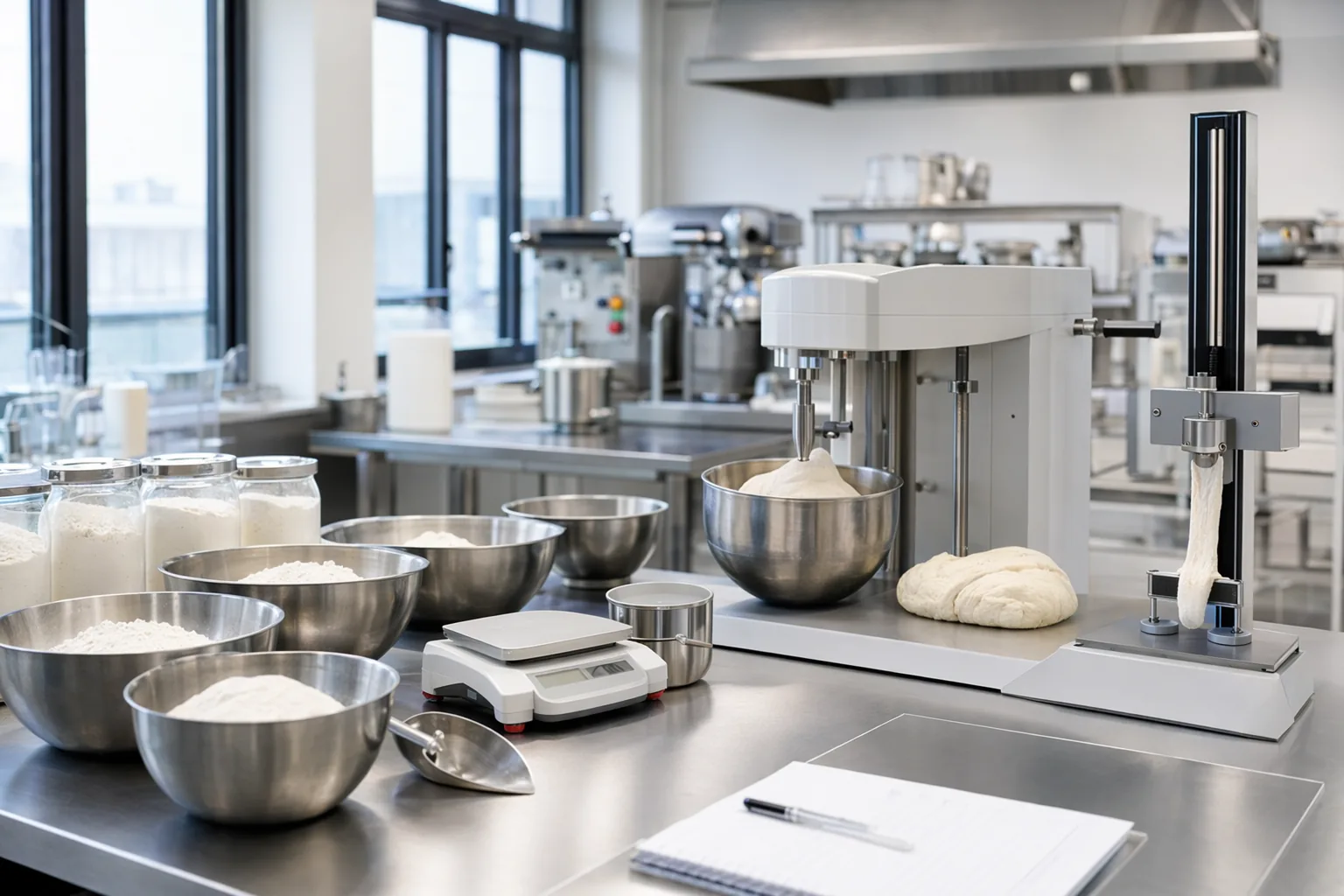
Source the right glucose oxidase enzyme for flour treatment, dough strengthening, and consistent industrial baking performance.
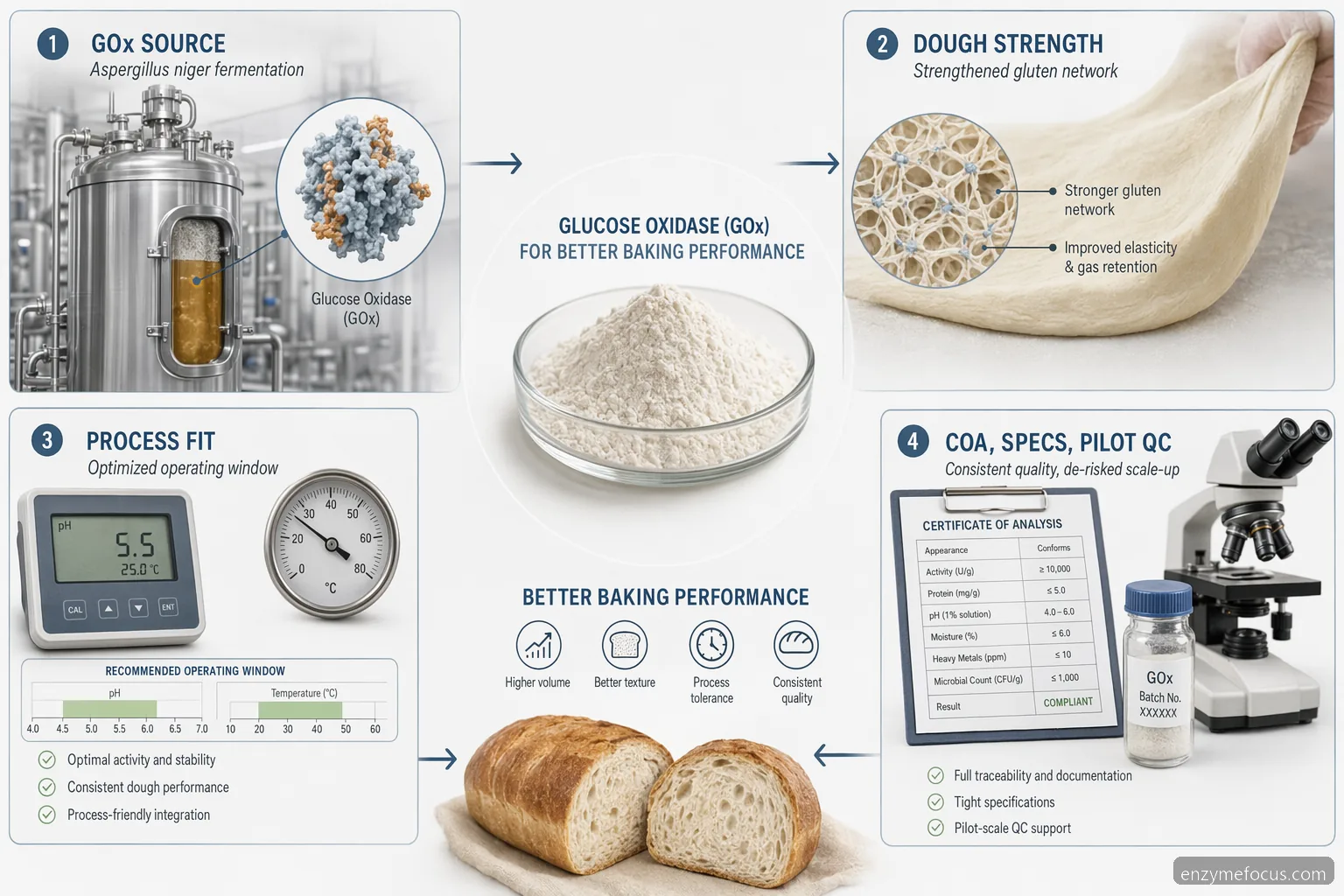
Why baking manufacturers specify Aspergillus niger GOx
Glucose oxidase from aspergillus niger is a widely evaluated source of GOx enzyme for commercial baking because it catalyzes glucose oxidation in the presence of oxygen, producing gluconic acid and hydrogen peroxide. In dough systems, the controlled oxidative effect can support gluten network strength, dough tolerance, gas retention, and loaf volume when the formula and process are suitable. Unlike the energy-yield discussion in glycolysis for each molecule of glucose oxidized to pyruvate, this application is about functional oxidation in dough, not nutrition or medical use. Buyers typically compare activity, carrier compatibility, dusting profile, solubility, and performance in their own flour stream. A suitable glucose oxidase enzyme should be selected by application trial, not only by catalog activity, because different mills, improvers, fats, reducing agents, and mixing methods change the response.
Primary use: baking improver systems and flour treatment • Key reaction: glucose oxidized with oxygen to support oxidative dough effects • Best fit: formulas where controlled strengthening is desired
Process conditions and dosage starting points
For baking trials, glucose oxidase is commonly screened in low ppm dosage ranges based on flour weight or enzyme preparation activity. A practical starting band is often 5–50 ppm of commercial preparation on flour, then adjusted by activity, flour strength, and target handling properties. The enzyme generally performs in mildly acidic to near-neutral dough systems, with a practical pH evaluation window around pH 4.5–7.0. Baking dough temperatures during mixing and proofing are usually compatible with enzyme action, while final oven heat inactivates the protein. Because hydrogen peroxide formation depends on oxygen availability and available glucose, mixing intensity and formula sugars matter. Trial designs should compare untreated control, low, medium, and high dose, then monitor dough extensibility, resistance, proof stability, loaf volume, crumb structure, and sensory impact.
Trial pH window: about 4.5–7.0 • Typical screening: 5–50 ppm commercial preparation on flour • Evaluate at actual plant mixing, proofing, and bake conditions • Avoid overdosing that may create excessive dough tightening
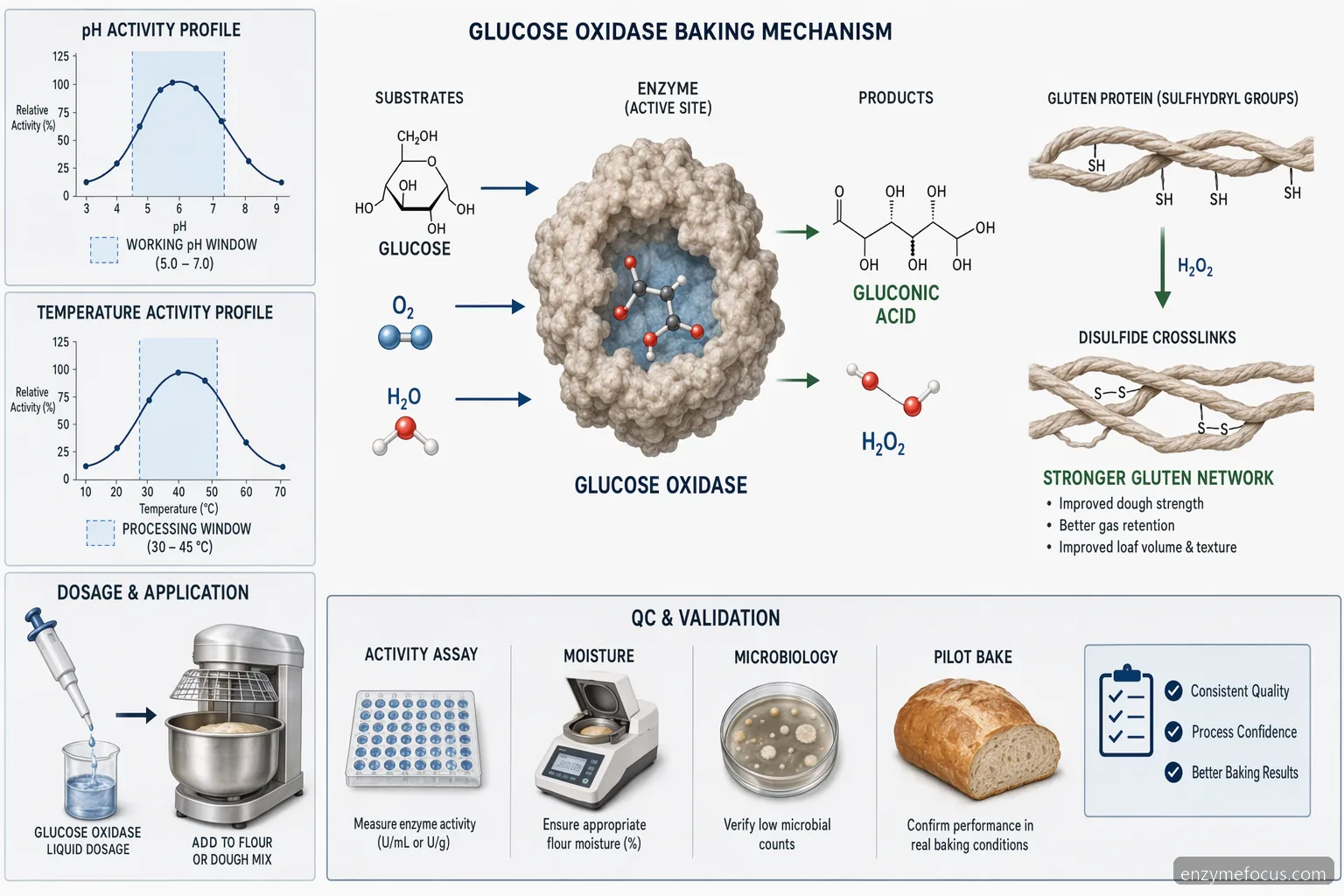
Quality documents buyers should request
Before a glucose oxidase from Aspergillus niger purchase, procurement and R&D teams should request a current COA, TDS, and SDS for the specific lot or product code under evaluation. The COA should state enzyme activity, activity method, manufacturing date or retest date, microbiological limits, heavy metal limits where applicable, and physical appearance. The TDS should explain recommended storage, solubility or dispersion guidance, carrier system, dosage guidance, and application notes for baking. The SDS supports safe handling, dust control, PPE planning, and warehouse training. Buyers comparing phrases such as glucose glucose oxidase or glucose oxidase from Aspergillus niger Type VII should confirm whether the material is industrial food-processing grade, lab reagent grade, or another format, because grade and intended use can differ significantly.
Request COA, TDS, SDS, allergen statement, and non-GMO statement if required • Confirm activity units and test method before comparing quotations • Check carrier compatibility with premixes and flour improvers • Verify shelf life, storage temperature, and packaging format
Pilot validation and QC checks
A strong supplier guide should move beyond desk specifications and into pilot validation. Run glucose oxidase baking trials with representative flour lots, actual mixing energy, normal water absorption targets, and the plant’s standard proofing schedule. Useful QC checks include farinograph or mixograph behavior, extensograph or alveograph response, dough stickiness, proof height, oven spring, loaf volume, crumb grain, sliceability, and finished-product shelf observation. Track pH shift where relevant and confirm that the enzyme does not create excessive strength in already strong flour. Include a side-by-side improver system comparison, because oxidants, emulsifiers, amylases, xylanases, and reducing agents can interact. For production approval, repeat trials across more than one flour lot and at least one extended storage condition for premixes containing the glucose oxidase enzyme.
Use control, target dose, and over-dose challenge • Validate in the complete improver system, not in isolation • Repeat trials across variable flour strength • Document cost-in-use per metric ton of flour or finished bread
Supplier qualification and cost-in-use
Industrial buyers should qualify glucose oxidase suppliers on technical support, lot consistency, documentation quality, lead time, packaging, and cost-in-use rather than unit price alone. Two products with the same headline activity may perform differently if activity methods, stabilizers, carriers, granulation, moisture, or storage history differ. Ask for retained-sample practices, change-control notification, complaint handling, and batch traceability. For bakeries using dry improver blends, evaluate dust, flow, segregation risk, and compatibility with salt, sugar, emulsifiers, and other enzymes. Cost-in-use should include dosage needed to reach the target dough effect, waste reduction, process tolerance, inventory life, and any reformulation savings. A reliable partner should support pilot trial interpretation, provide clear technical documents, and help scale from bench to plant without overstating benefits.
Compare delivered cost per effective dose, not only price per kilogram • Confirm packaging sizes for pilot, scale-up, and routine production • Request batch consistency data before annual supply approval • Include supply continuity and lead time in vendor scoring
Technical Buying Checklist
Buyer Questions
Glucose oxidase catalyzes glucose oxidation in the presence of oxygen, forming gluconic acid and hydrogen peroxide. In dough, the controlled oxidative effect can strengthen gluten interactions and improve dough handling, proof tolerance, and loaf structure. Results depend on flour quality, formula design, mixing energy, oxygen incorporation, and enzyme dosage, so pilot validation is required before production approval.
Choose a supplier based on documented enzyme activity, clear COA/TDS/SDS support, batch traceability, application expertise, packaging fit, lead time, and change-control communication. Request samples for pilot baking trials and compare cost-in-use at equivalent finished-product performance. Avoid selecting only by quoted activity or price per kilogram, because activity methods and carriers can differ.
A common screening range is about 5–50 ppm of the commercial glucose oxidase preparation on flour weight, but the correct dose depends on activity, flour strength, formula, and target dough effect. Run untreated control, low, medium, and high-dose trials. Watch for excessive tightening, reduced extensibility, or negative crumb effects at higher levels.
Not necessarily. Some catalog descriptions, including Type VII-style terminology, may refer to reagent or analytical materials rather than industrial baking ingredients. For food manufacturing, confirm intended use, food-processing suitability, carrier system, safety documentation, and regulatory documentation relevant to your market. Procurement should qualify the exact product and lot proposed for production.
Before purchase, request a product TDS, SDS, and recent COA for the glucose oxidase lot or representative batch. Also ask for the activity assay method, storage conditions, shelf life, carrier information, allergen statement where required, and traceability details. For larger programs, include pilot-trial support, batch consistency data, and supply continuity information in the qualification file.
Related Search Themes
glucose oxidase, in glycolysis for each molecule of glucose oxidized to pyruvate, glucose oxidized, glucose oxidation, glucose glucose oxidase, glucose oxidase from aspergillus niger type vii
Glucose Oxidase for Research & Industry
Need Glucose Oxidase for your lab or production process?
ISO 9001 certified · Food-grade & research-grade · Ships to 80+ countries
Frequently Asked Questions
What does glucose oxidase do in baking?
Glucose oxidase catalyzes glucose oxidation in the presence of oxygen, forming gluconic acid and hydrogen peroxide. In dough, the controlled oxidative effect can strengthen gluten interactions and improve dough handling, proof tolerance, and loaf structure. Results depend on flour quality, formula design, mixing energy, oxygen incorporation, and enzyme dosage, so pilot validation is required before production approval.
How should I choose a glucose oxidase from Aspergillus niger supplier?
Choose a supplier based on documented enzyme activity, clear COA/TDS/SDS support, batch traceability, application expertise, packaging fit, lead time, and change-control communication. Request samples for pilot baking trials and compare cost-in-use at equivalent finished-product performance. Avoid selecting only by quoted activity or price per kilogram, because activity methods and carriers can differ.
What dosage should a bakery test first?
A common screening range is about 5–50 ppm of the commercial glucose oxidase preparation on flour weight, but the correct dose depends on activity, flour strength, formula, and target dough effect. Run untreated control, low, medium, and high-dose trials. Watch for excessive tightening, reduced extensibility, or negative crumb effects at higher levels.
Is glucose oxidase the same as a laboratory reagent grade product?
Not necessarily. Some catalog descriptions, including Type VII-style terminology, may refer to reagent or analytical materials rather than industrial baking ingredients. For food manufacturing, confirm intended use, food-processing suitability, carrier system, safety documentation, and regulatory documentation relevant to your market. Procurement should qualify the exact product and lot proposed for production.
What documents are needed before purchase?
Before purchase, request a product TDS, SDS, and recent COA for the glucose oxidase lot or representative batch. Also ask for the activity assay method, storage conditions, shelf life, carrier information, allergen statement where required, and traceability details. For larger programs, include pilot-trial support, batch consistency data, and supply continuity information in the qualification file.
Related: Glucose Oxidase Method Reagent for Oxidation Control
Turn This Guide Into a Supplier Brief Request glucose oxidase specifications, samples, and pilot support for your baking application. See our application page for Glucose Oxidase Method Reagent for Oxidation Control at /applications/glucose-oxidase-method-peroxidase/ for specs, MOQ, and a free 50 g sample.
Contact Us to Contribute