Glucose Oxidase for Baking: Process Guide
B2B guide to glucose oxidase for baking: dosage, pH, temperature, QC checks, COA/TDS/SDS review, pilot trials, and supplier qualification.
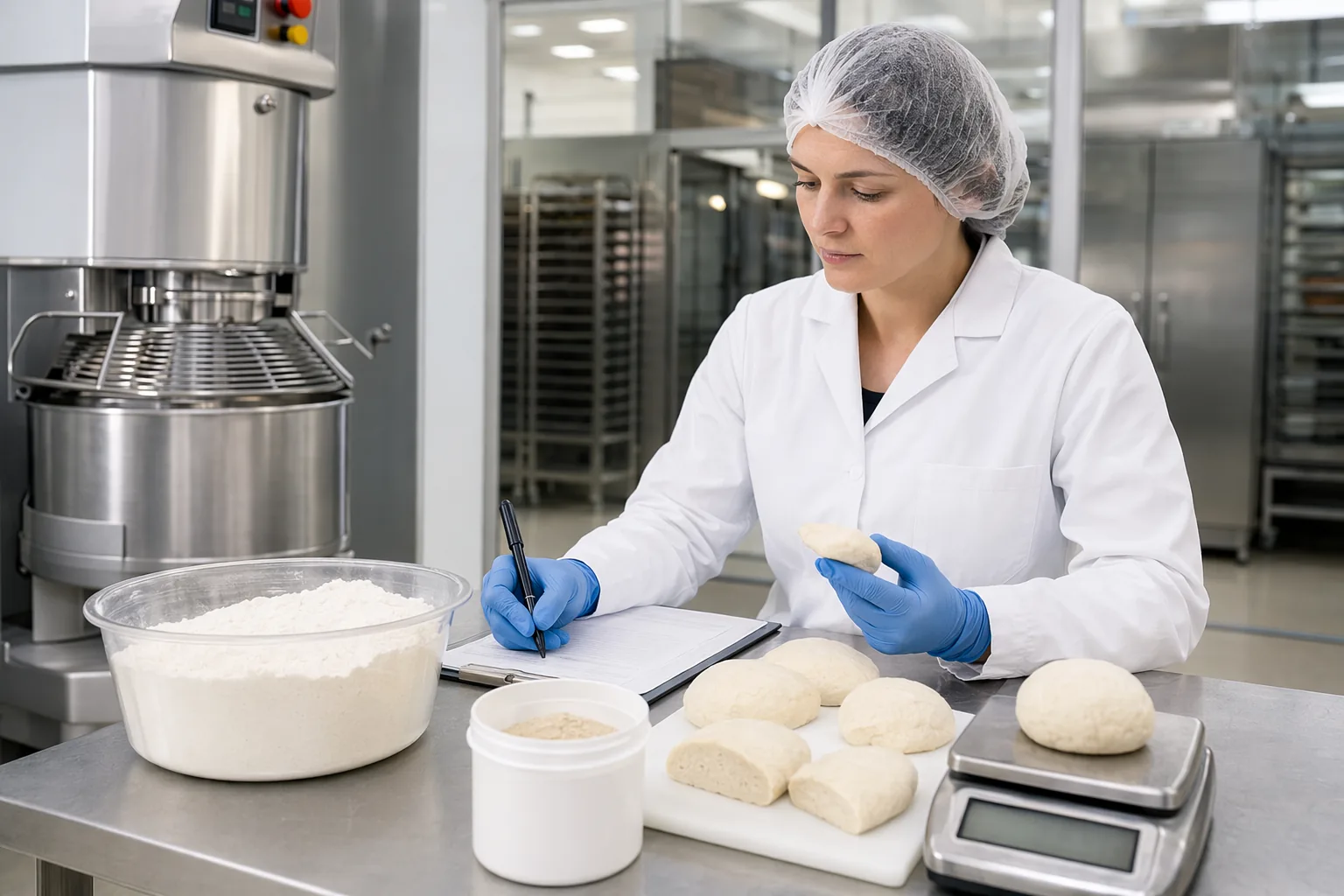
Use glucose oxidase to strengthen dough systems, improve handling, and support consistent industrial baking performance through controlled oxidation. Written for bakery manufacturers, flour mills and ingredient distributors buying glucose oxidase in bulk; grades and volumes are quoted per order.
How Glucose Oxidase Works in Dough
Glucose oxidase, often abbreviated as the GOx enzyme, catalyzes the oxidation of glucose in the presence of oxygen. In bakery dough, the glucose oxidase enzyme converts glucose to glucono-delta-lactone, which hydrolyzes to gluconic acid, while hydrogen peroxide is formed as a reactive by-product. In controlled amounts, this peroxide can promote oxidation of sulfhydryl groups in gluten proteins, supporting disulfide bond formation and a stronger dough network. For industrial bakers, the practical outcome may include reduced stickiness, improved machining tolerance, better gas retention, and more consistent volume. The effect depends strongly on flour protein quality, available glucose, oxygen incorporation during mixing, water absorption, and formula reducing agents.
Primary reaction: glucose plus oxygen produces gluconic acid and hydrogen peroxide. • Main baking function: controlled dough oxidation and gluten network strengthening. • Performance depends on flour, formula, mixing, proofing, and oxygen availability.
Recommended Process Conditions for Bakery Trials
A practical glucose oxidase baking trial should begin with conservative addition rates and a clear control formula. Many commercial evaluations start around 10 to 100 g enzyme preparation per metric ton of flour, or approximately 5 to 50 ppm flour basis, depending on declared activity and formulation strength. Because activity units differ by supplier, dosage should always be normalized through the technical data sheet and verified by pilot baking. The enzyme is generally useful in dough pH ranges near 4.5 to 6.5 and common mixing temperatures around 20 to 32°C, with activity declining as dough heats during baking. Avoid assuming that higher dosage improves quality; excessive oxidation may tighten dough, reduce extensibility, or create dense crumb. Validate across seasonal flour lots, hydration levels, fermentation windows, and line speeds before plant-scale adoption.
Start low, then increase stepwise against a no-enzyme control. • Record dough temperature after mixing and before makeup. • Check interaction with ascorbic acid, reducing agents, emulsifiers, and other enzymes. • Confirm final bake inactivates residual enzyme activity.
Application Targets: Bread, Buns, and Frozen Dough
In pan bread and buns, glucose oxidase can help strengthen dough during high-speed mixing, dividing, rounding, and sheeting. This is valuable where flour quality fluctuates or where mechanical stress causes dough weakness. In frozen dough, controlled oxidation may support dough tolerance after thawing and proofing, but it must be balanced carefully because over-strengthening can reduce expansion. The phrase “glucose glucose oxidase” is sometimes used in search queries, but industrial formulation teams should focus on the ratio of available glucose, oxygen uptake, and enzyme activity. Sugar level matters: even formulas without added glucose may contain fermentable sugars from flour or amylase activity, while sweet dough systems require separate validation. For tortillas, flatbreads, and laminated products, the target may be reduced stickiness and improved handling rather than maximum volume. Define the desired texture before setting the enzyme dosage.
Bread and buns: improve tolerance and gas retention. • Frozen dough: evaluate after freeze-thaw and proofing. • Flatbreads: assess extensibility, stickiness, and sheeting behavior. • Sweet dough: validate separately due to sugar and fat effects.
Quality Control and Assay Strategy
A robust glucose oxidase assay program should connect enzyme activity to finished-product performance. At incoming inspection, confirm the certificate of analysis against purchase specifications, including activity, batch number, appearance, carrier, moisture if listed, and microbiological limits where applicable. In the bakery lab, pair analytical checks with functional testing: farinograph or mixograph absorption, extensograph or alveograph strength, dough stickiness, proof height, oven spring, loaf volume, crumb grain, and slicing performance. Track pH because gluconic acid formation can slightly shift dough acidity, especially in low-buffer systems. Keep retained samples and compare performance after storage to assess activity stability.
Incoming QC: COA match, activity, lot traceability, and packaging integrity. • Functional QC: rheology, loaf volume, crumb, and process tolerance. • Stability QC: monitor activity over storage under recommended conditions.
Supplier Qualification and Cost-in-Use
For B2B procurement, the lowest price per kilogram is rarely the best comparison point. Evaluate cost-in-use based on enzyme activity, effective dosage, yield impact, waste reduction, and line efficiency. Request a current TDS for activity definition and application guidance, an SDS for safe handling, and a COA for each batch shipped. Confirm allergen statements, carrier composition, country of origin if required, shelf life, storage temperature, packaging size, and lead time. Supplier qualification should include audit readiness, change-control communication, batch consistency, technical support, and pilot validation support. Ask how the activity method is performed and whether the same method is used for release testing. Because oxidation of glucose in dough is sensitive to formula and process conditions, qualify at least one backup supplier only after side-by-side plant or pilot trials demonstrate equivalent baking performance.
Compare suppliers by cost-in-use, not only unit price. • Require COA, TDS, SDS, activity method, and lot traceability. • Run pilot validation before approving production-scale use. • Document supplier change-control expectations.
Technical Buying Checklist
Buyer Questions
Glucose oxidase catalyzes glucose oxidation in dough, using oxygen to form gluconic acid and hydrogen peroxide. In controlled amounts, hydrogen peroxide can promote protein oxidation and strengthen the gluten network. Industrial bakers use it to improve dough handling, reduce stickiness, support gas retention, and increase process tolerance. Results depend on flour quality, formula, mixing, proofing, and enzyme dosage.
A common starting range for bakery trials is about 10 to 100 g of enzyme preparation per metric ton of flour, or roughly 5 to 50 ppm flour basis. The correct level depends on the supplier’s activity units, flour strength, product type, and process conditions. Always begin with a control, increase dosage stepwise, and validate through pilot bakes before plant use.
Buyers should request a current certificate of analysis, technical data sheet, safety data sheet, activity assay description, allergen and carrier information, shelf-life statement, storage guidance, and lot traceability details. For supplier qualification, also assess batch consistency, technical support, lead time, change-control communication, and pilot validation support. Cost-in-use should be calculated from activity and effective dosage.
Yes, glucose oxidase is often evaluated alongside amylases, xylanases, lipases, proteases, or emulsifier systems, but interactions must be tested. Amylases can influence fermentable sugar availability, while reducing agents or oxidants can change dough response. Build trials around the full formula, not the enzyme alone. Measure rheology, volume, crumb, sensory properties, and production tolerance before approving a blend.
Glucose Oxidase for Research & Industry
Need Glucose Oxidase for your lab or production process?
ISO 9001 certified · Food-grade & research-grade · Ships to 80+ countries
Frequently Asked Questions
What does glucose oxidase do in baking?
Glucose oxidase catalyzes glucose oxidation in dough, using oxygen to form gluconic acid and hydrogen peroxide. In controlled amounts, hydrogen peroxide can promote protein oxidation and strengthen the gluten network. Industrial bakers use it to improve dough handling, reduce stickiness, support gas retention, and increase process tolerance. Results depend on flour quality, formula, mixing, proofing, and enzyme dosage.
What dosage of glucose oxidase should a bakery start with?
A common starting range for bakery trials is about 10 to 100 g of enzyme preparation per metric ton of flour, or roughly 5 to 50 ppm flour basis. The correct level depends on the supplier’s activity units, flour strength, product type, and process conditions. Always begin with a control, increase dosage stepwise, and validate through pilot bakes before plant use.
What documents should buyers request from a glucose oxidase supplier?
Buyers should request a current certificate of analysis, technical data sheet, safety data sheet, activity assay description, allergen and carrier information, shelf-life statement, storage guidance, and lot traceability details. For supplier qualification, also assess batch consistency, technical support, lead time, change-control communication, and pilot validation support. Cost-in-use should be calculated from activity and effective dosage.
Can glucose oxidase be used with other baking enzymes?
Yes, glucose oxidase is often evaluated alongside amylases, xylanases, lipases, proteases, or emulsifier systems, but interactions must be tested. Amylases can influence fermentable sugar availability, while reducing agents or oxidants can change dough response. Build trials around the full formula, not the enzyme alone. Measure rheology, volume, crumb, sensory properties, and production tolerance before approving a blend.
Wholesale Glucose Oxidase: Request a Quote
For manufacturers, distributors and resellers: send the application, the quantity and the destination country for a quote. Turn This Guide Into a Supplier Brief Request a glucose oxidase baking evaluation pack with COA, TDS, SDS, and pilot-trial guidance. See our application page for Glucose Oxidase Method Reagent for Oxidation Control at /applications/glucose-oxidase-method-peroxidase/ for specs, MOQ, and a free 50 g sample.
Contact Us to Contributehello@mail.enzymefocus.com